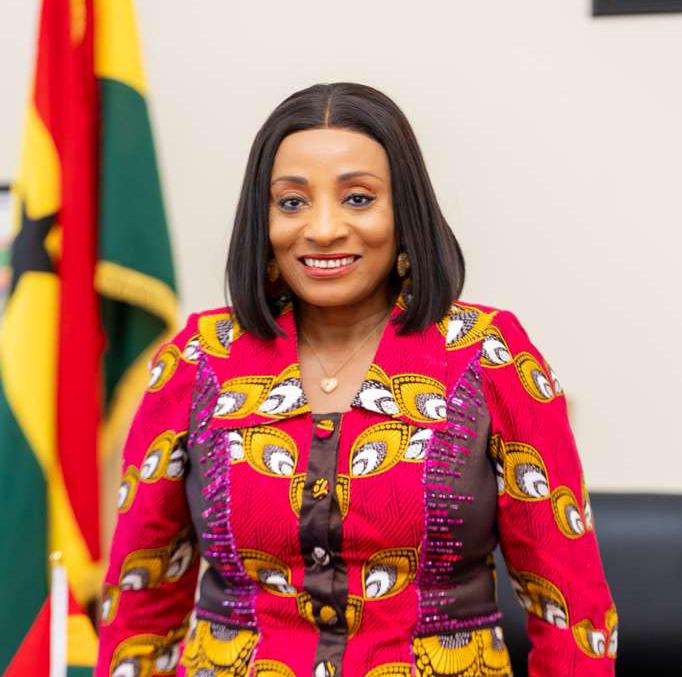
Ghana’s High Commissioner to the United Kingdom, Mrs Sabah Zita Benson, has called for Africa to take a more central role in the global green economy, stressing the need for the continent to move beyond raw material exports and focus on building value-added industries that generate jobs, skills, and long-term prosperity.
She made the call at the 3rd International Conference on African Development (iCAD 2026), held at Anglia Ruskin University in Cambridge on Thursday, June 18, 2026, under the theme “Green Transitions and Inclusive Industrialisation in Africa: Theory to Policy and Practice.”
Addressing academics, policymakers, business leaders, and students, Mrs Benson said Africa’s development trajectory depends on stronger alignment between research, policy, financing, and implementation.
“For Ghana, and for many African countries, the challenge of development has never been a shortage of talent, creativity or ambition,” she said.
“Our continent is rich in natural resources, human capital, cultural intelligence and entrepreneurial energy. What we have often lacked is the full alignment of policy, infrastructure, financing, technology and policy implementation.”
She stressed that the green transition must be understood not only as an environmental priority but also as a driver of economic transformation across key sectors, including energy, agriculture, transport, manufacturing, technology, education, and housing.
Mrs Benson further noted that Africa’s industrialisation agenda must prioritise decent job creation, support for local enterprises, and inclusive growth that benefits women and young people.
“Growth that destroys the environment cannot be responsible. Development that depends only on exporting raw materials cannot deliver the prosperity our people deserve,” she said.
She warned that without deliberate policy action, Africa risks remaining primarily a supplier of critical minerals and raw materials for wealthier economies, rather than benefiting fully from its own resources.
“Africa must not be positioned merely as a supplier of raw materials for the green economies of others,” she said. “We must be active participants, innovators, manufacturers, financiers, researchers and policy shapers in the global green economy.”
Mrs Benson emphasised the need for Africa to develop local value chains that allow the continent to capture more economic benefits from its natural resources.
“Africa must capture value, create industries, develop skills and build prosperity from within,” she stated.
She also highlighted the role of universities in driving development, calling on higher education institutions to focus on producing problem-solvers equipped to address real-world challenges.
“Universities have a central role to play. They must not only produce graduates. They must produce problem solvers, who understand the complexity of development,” she said.
The High Commissioner called for stronger collaboration between governments, the private sector, and academia, noting that sustainable development cannot be achieved in isolation.
She also urged Ghana and other African countries to better harness the potential of their diaspora communities, describing them as a key asset for national development.
“The Ghanaian diaspora remains one of our greatest assets,” she said, pointing to the expertise, networks, and experience of Ghanaians abroad as critical resources for national growth.
On financing Africa’s green industrialisation agenda, Mrs Benson cautioned that public funds alone would not be sufficient, calling instead for increased public-private partnerships, diaspora investment, and innovative financing mechanisms supported by strong governance frameworks.
“Ambition without financing remains aspiration,” she said.
She further encouraged researchers to ensure their work informs policy and delivers tangible impact beyond academic publications.
“Research must not end only in journal articles, it must also inform legislation, regulation, public investment, business strategy and community action,” she said.
The conference brought together scholars, policymakers, industry leaders, and development partners to explore pathways for sustainable and inclusive growth across Africa, with a focus on translating ideas into practical development outcomes.