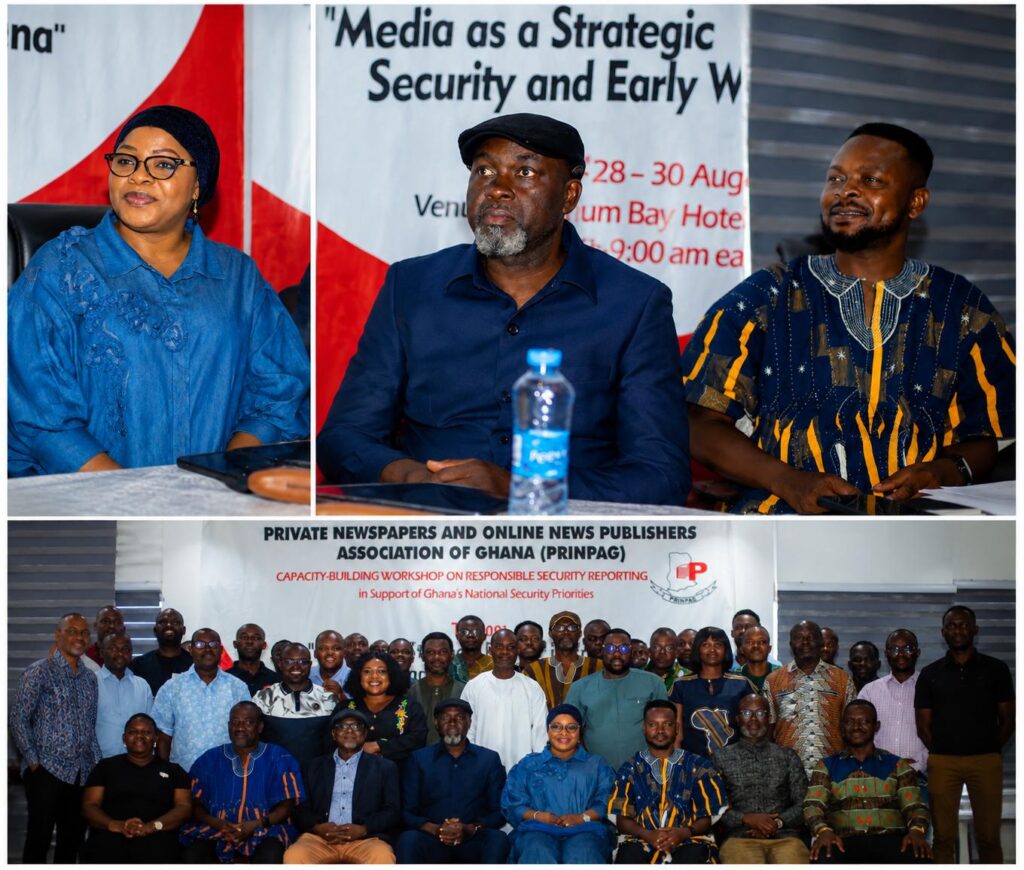
The National Security Secretariat is to establish a structured communication channel with newsrooms to enable journalists to obtain timely clarification on sensitive security matters and help curb speculation during periods of national uncertainty.
The National Security Coordinator, COP Osman Abdul-Razak, said the initiative formed part of efforts to strengthen cooperation between the security services and the media while promoting accurate and responsible reporting on national security issues.
He made the disclosure at a two-day capacity-building workshop organised by the Private Newspapers and Online News Publishers Association of Ghana (PRINPAG), in collaboration with the National Security Secretariat, at the Platinum Bay Hotel at Abokobi in Accra.
The workshop, held on the theme, “Media as a Strategic Partner in Preventive Security and Early Warning in Ghana,” brought together publishers, media owners and senior editors to enhance their understanding of the country’s changing security environment.
COP Abdul-Razak said the proposed communication mechanism would provide journalists with a dependable avenue to verify information with the security authorities, particularly when developments had the potential to heighten public anxiety.
“My office is ready to establish a standard channel of dialogue between the security services and your newsrooms so that clarity replaces regulations in moments of national anxiety… and to work with you on guidelines of security reporting drawn up with you and not for you,” he said.
He stressed that any guidelines for security reporting should be developed jointly with media practitioners rather than imposed on them, adding that PRINPAG should take the lead in developing a practical framework for engagement between the media and security institutions.
The National Security Coordinator also announced plans to support periodic specialised training for journalists and editors and facilitate access to key security officials and field operations.
Such engagements, he said, could expose journalists to the work of the security agencies and provide opportunities to interact with soldiers and police officers on issues including terrorism, violent extremism and other emerging threats.
He expressed the hope that stronger cooperation would reduce information gaps, improve public understanding of security matters and enable the media to contribute more effectively to national early-warning and preventive-security efforts.
Defending the role of the private media
The President of PRINPAG, Mr David Tamakloe, said the association remained committed to defending professional journalism and strengthening the private media despite the growing challenges confronting the industry.
He said PRINPAG had, since its establishment in 1991, served as a peer-review platform and watchdog for the private press, while supporting practitioners and promoting professional standards.
Mr Tamakloe criticised attempts to portray traditional journalism as obsolete because of the rapid growth of social media, arguing that the emergence of digital platforms did not diminish the importance of professional journalism.
He said social media should not be confused with journalism, stressing that the profession remained critical to democracy because of its role in holding power accountable, exposing wrongdoing and preserving society’s collective memory.
He also called for greater investment and appropriate regulation to strengthen the private media, arguing that journalists could not effectively discharge their democratic responsibilities without adequate resources.
“The pen is mightier than the sword. But a pen without ink is useless. Let us provide the ink through funding, through regulation, and through partnership,” he said.
Mr Tamakloe, however, acknowledged that resources alone would not guarantee a stronger media and urged journalists to uphold integrity, accuracy, professionalism and the national interest in the discharge of their duties.
Focus on security reporting
Participants at the workshop were taken through Ghana’s national security architecture, emerging and asymmetric security threats, communal conflicts, conflict sensitivity and strategic security communication.
They also examined the Security and Intelligence Agencies Act, 2026 (Act 1168), with discussions focusing on developments introduced by the legislation, as well as the relationship between the media and national security.
Other areas covered included media ethics, the national interest, press freedom and responsible reporting of security-related issues.
Mr Tamakloe urged PRINPAG members who participated in the workshop to share the knowledge acquired with colleagues and become ambassadors of accurate, responsible and conflict-sensitive journalism.
He also encouraged journalists who were unable to attend to maintain professional standards when covering security matters and commended the National Security Secretariat for partnering PRINPAG to strengthen the capacity of media practitioners.
The workshop is expected to contribute to a stronger working relationship between the media and security institutions while equipping journalists with the skills to identify, verify and responsibly report security threats before they escalate.
Story By: Sheila Otuo-Baffour