
Accra, Ghana: Ghana is targeting self-sufficiency in rice production by 2028, with government setting a national target of 3.31 million metric tonnes of paddy rice as part of efforts to reduce dependence on imports.
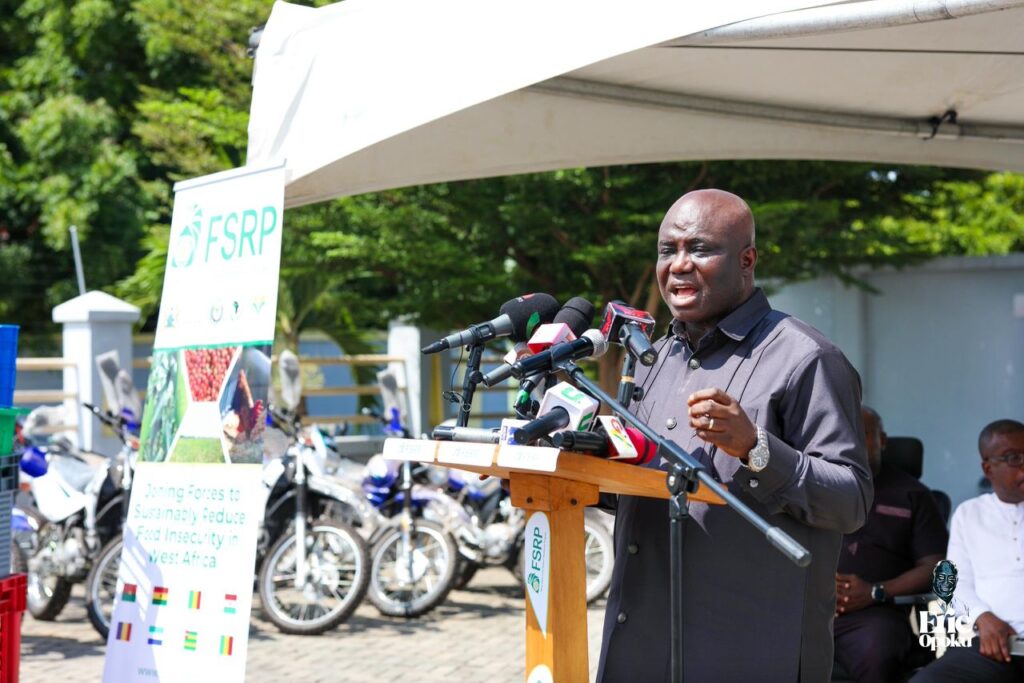
The Minister for Food and Agriculture, Eric Opoku, announced the target at a press briefing in Accra on Wednesday, October 7, 2026, where he outlined government’s plans to expand domestic rice production under the Regional West Africa Resilient Rice Value Chains Development (REWARD) Project.
The project is being supported by an US$18.8 million grant from the African Development Bank (AfDB) and forms part of the government’s Feed Ghana Programme.
Local production covers 56% of demand
Mr. Opoku said rice has become Ghana’s second most important cereal after maize, with population growth, urbanisation and changing consumer preferences driving increased demand.
He said domestic rice production has recorded significant growth, with milled rice production increasing from about 650,000 tonnes to 900,000 tonnes in 2024, before reaching approximately 960,000 tonnes in 2025.
Despite the growth, the Minister said local production currently meets only about 56 percent of national demand, leaving a 44 percent supply gap that is largely filled through imports.
Ghana spends between US$320 million and US$500 million annually on rice imports, a situation Mr. Opoku said represents an opportunity to retain more resources within the domestic economy by strengthening local production.
3,200 hectares to be developed
Under the REWARD Project, government plans to develop 3,200 hectares of land for rice production in the Northern Savannah Ecological Zone.
More than 20,000 smallholder farmers across selected districts are expected to benefit from the project.
The beneficiary areas include Tamale Metropolitan, Mion, Savelugu, East Mamprusi, West Gonja, Bawku West, Wa Municipal, Sissala East and Nandom.
The project will provide farmers with improved seeds and mechanisation support, with the aim of increasing average yields from about 3.5 tonnes to 4.5 tonnes per hectare while improving the quality of locally produced paddy.
Mechanisation and processing support
The Minister said farmers will have access to agricultural machinery including rotary tillers, seed drills, mini crawler combine harvesters, rice transplanters and boom sprayers.
Government will also identify and equip 10 strategically located rice processing centres with complementary equipment, including mini GEM rice parboiling vessels.
To address post-harvest losses, the project will provide hermetic storage cocoons, while farmers will be connected to markets and private-sector players to improve incomes and create employment opportunities along the rice value chain.
Rice produced under the project is also expected to supply schools, prisons and other public institutions, increasing the market for locally produced rice.
Government to link imports to local production
On rice imports, Mr. Opoku said government would not impose a blanket ban, arguing that such a move could negatively affect consumers.
Instead, he said the government would introduce measures linking import quotas to local investment and production.
Importers would be required to establish verifiable partnerships with local rice producers before receiving import permits.
“We are not banning imports, which would only hurt consumers. Instead, we are channelling the value of imports into local production and empowering our farmers,” Mr. Opoku said.
Japan provides additional support
The Minister also announced additional support from the Government of Japan, through a ¥394 million grant, estimated at about US$2.49 million, to strengthen Ghana’s rice value chain.
The support is being provided under the CARD Grant Aid Project on the Enhancement of Rice Seeds Production Capacity.
The Japanese assistance will include combine harvesters, trucks for transporting harvesters and seeds, seed-cleaning machines, maintenance tools, air blowers and dusters, high-pressure cleaners, transformers and a vehicle for monitoring and supervision.
The equipment is expected to arrive in November 2026, alongside training for actors across the rice value chain.
REWARD Project launch expected in November
Mr. Opoku urged farmers and other beneficiaries to use the equipment and support responsibly, stressing that effective utilisation would be critical to achieving sustainable food and nutrition security.
The Ministry, in consultation with the African Development Bank, is expected to formally launch the REWARD Project in the first week of November 2026, ahead of the 2027 production season.
The government says the intervention will help transform Ghana’s rice industry, create jobs, improve farmer incomes, strengthen food security and reduce the country’s annual rice import bill.
If successfully implemented, the programme could also strengthen Ghana’s capacity to meet growing domestic demand with locally produced rice, while creating stronger links between farmers, processors, institutional buyers and the private sector.