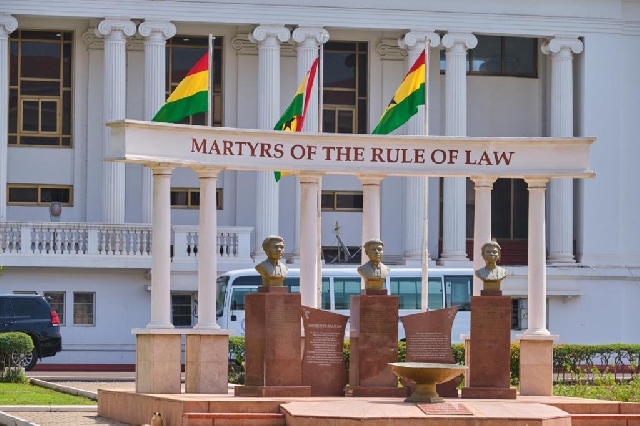
A Ghanaian citizen has filed a suit at the Supreme Court seeking to strike down portions of the Criminal Offences Act, 1960 (Act 29) and the Electronic Communications Act, 2008 (Act 775), arguing that the laws violate constitutional guarantees on freedom of speech, expression and media freedom.
The plaintiff, Austin Kwabena Brako-Powers, through his lawyer Michael Akosah, filed the action at the Supreme Court Registry in Accra in May 2026, naming the Attorney-General as the sole respondent.
The suit specifically challenges Section 208(1) of Act 29, which criminalises the publication of statements, rumours or reports considered likely to cause fear, alarm or disturb public peace.
According to the plaintiff, the provision is vague, overly broad and imposes unjustifiable restrictions on rights protected under Articles 21(1)(a) and (b) as well as Article 162 of the 1992 Constitution, which safeguard freedom of speech and press freedom.
The plaintiff is also contesting Section 208(2) of Act 29, which places the burden on an accused person to prove that reasonable steps were taken to verify the accuracy of a publication.
Court documents argue that the provision removes the defence of honest belief in the truth of a publication and could expose journalists, media practitioners and ordinary citizens to criminal prosecution for statements later found to be inaccurate, even in the absence of deliberate or reckless falsehood.
The suit further challenges Section 76(1) of Act 775, which criminalises the transmission of “false or misleading” electronic communications.
According to the plaintiff, the law fails to clearly define what constitutes “false or misleading” communication, making it inconsistent with Article 19(11) of the Constitution.
The plaintiff is asking the Supreme Court to interpret the provision narrowly so that it applies only to knowingly false communications intentionally transmitted to endanger lives or disrupt life-saving services, rather than communications based on mistakes, opinions or misinformation shared without malicious intent.
Section 76(2) of Act 775 is also being challenged on grounds that it violates constitutional protections on free speech and the presumption of innocence.
The suit argues that the provision unlawfully reverses the burden of proof by presuming that an accused person knew a communication was false or misleading simply because they failed to take reasonable steps to verify its accuracy.
The plaintiff further referenced Ghana’s obligations under international human rights instruments, including the International Covenant on Civil and Political Rights (ICCPR), in support of the case.
Among the reliefs sought, the plaintiff is asking the Supreme Court to declare Sections 208(1) and (2) of Act 29 and Sections 76(1) and (2) of Act 775 unconstitutional, null and unenforceable.