The Institute for Energy Security (IES) has welcomed government’s settlement of US$1.47 billion in energy sector arrears for the 2025 fiscal year, describing the move as a critical intervention that has helped avert a potential collapse of Ghana’s power system. DOC-20260112-WA0056.
In a statement issued on January 12, 2026, the policy think tank said the payment followed a period of heightened systemic risk marked by the depletion of the World Bank Partial Risk Guarantee (PRG) and the accumulation of legacy debts in the energy sector. According to IES, the massive capital injection acted as “life support” for the national grid at a time when power security was under serious threat. DOC-20260112-WA0056.
Boost to Energy Security
IES identified three major areas where the debt clearance is already making an impact on Ghana’s energy stability.
First, the settlement has enabled the restoration of the US$500 million World Bank PRG, a key credit enhancement instrument that supports the Sankofa Gas Project. The think tank noted that this restoration lowers the sector’s risk profile and reassures international partners such as ENI and Vitol, helping to sustain uninterrupted gas production.
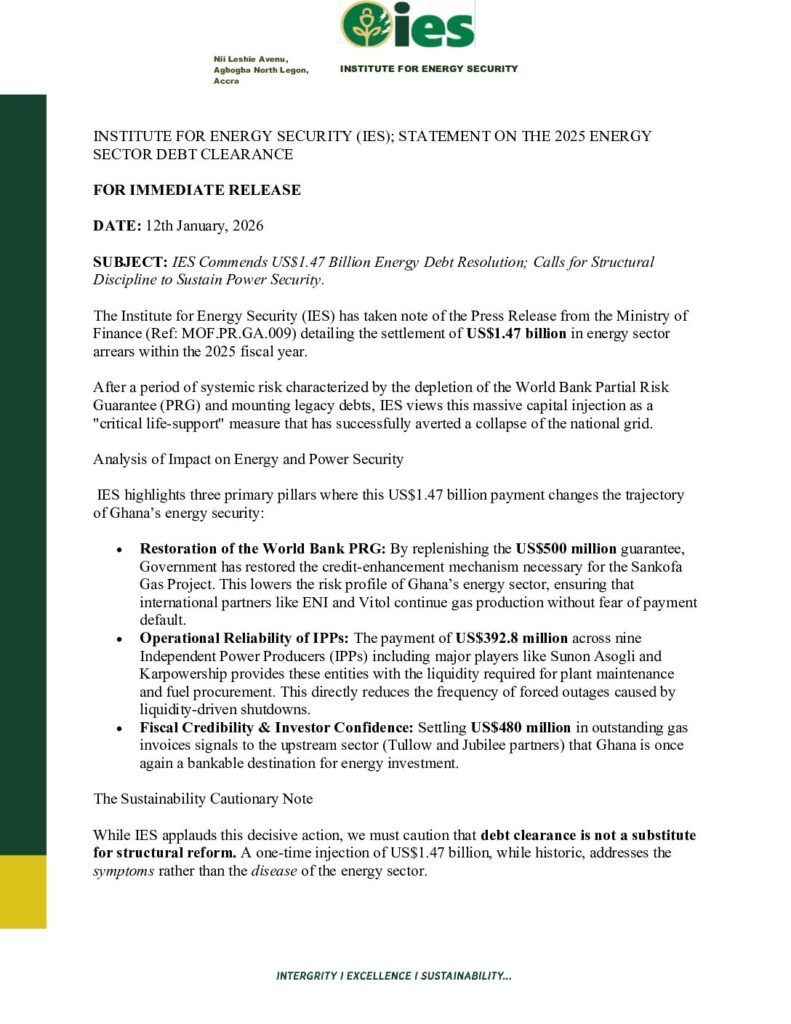
Secondly, government paid about US$392.8 million to nine Independent Power Producers (IPPs), including Sunon Asogli and Karpowership. IES explained that this liquidity will allow power producers to carry out plant maintenance and secure fuel supplies, reducing the likelihood of forced shutdowns linked to cash flow challenges.
The third benefit, according to the institute, is improved fiscal credibility. Settlement of approximately US$480 million in outstanding gas invoices has restored confidence among upstream operators such as Tullow and Jubilee partners, signalling that Ghana is once again a credible destination for energy investment. DOC-20260112-WA0056.
Sustainability Concerns
Despite applauding the intervention, IES cautioned that clearing debts alone will not fix the long-standing structural weaknesses in the energy sector.
The institute warned that without deeper reforms, new legacy debts could begin to accumulate as early as 2027. Key vulnerabilities highlighted include high technical and commercial losses within the Electricity Company of Ghana (ECG) distribution system, as well as exchange rate volatility, since most IPP contracts are denominated in US dollars while revenues are collected in cedis. DOC-20260112-WA0056.
Roadmap for Long-Term Stability
To sustain power security and prevent future debt build-up, IES outlined several policy recommendations.
These include full automation of the Cash Waterfall Mechanism to ensure transparent and interference-free revenue distribution across the power value chain, and an aggressive nationwide metering programme to improve revenue protection and reduce commercial losses.
The institute also called for greater optimisation of domestic gas resources, urging government to prioritise local gas production over expensive imported liquefied natural gas. Additionally, IES advocated transparency in the ongoing renegotiation of IPP contracts to guarantee value for money for taxpayers. DOC-20260112-WA0056.
Looking Ahead
IES described 2025 as a turning point for Ghana’s energy sector, noting that the Mahama administration has succeeded in pulling the industry back from the brink. However, the institute stressed that the real test lies in the government’s ability to maintain a zero-arrears policy beyond 2026 and sustain fiscal discipline across the sector. DOC-20260112-WA0056.
The statement was signed by Smith Prosper Boahene, Senior Research and Policy Analyst at the Institute for Energy Security.