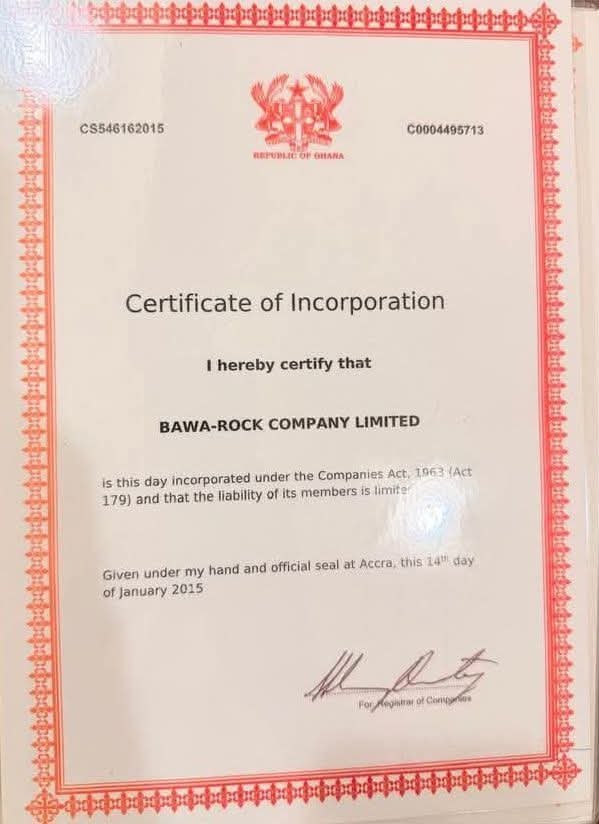
A business registration certificate circulating on social media indicates that Bawa Rock Company Limited was incorporated in 2015, countering widespread claims that the company was registered only recently.
The document has re-emerged amid intense public debate following comments by Hon. Kojo Oppong Nkrumah, Member of Parliament for Ofoase Ayirebi, who has raised concerns about Ghana’s current gold purchase and aggregation arrangements.
In recent days, the Ghanaian media space has been flooded with reports suggesting that Bawa Rock Company Limited was newly formed and subsequently granted a dominant role within the gold trading system. These claims have fueled public suspicion and renewed calls for transparency and accountability in the management of the country’s gold resources.
However, the appearance of the 2015 registration certificate challenges the narrative of recent incorporation and has shifted the focus toward the company’s operational role, licensing status, and relationship with state institutions, rather than its date of registration alone.
Responding to the allegations, the Chief Executive Officer of the Gold Board, Mr. Sammy Gyamfi, has dismissed claims that the company was hurriedly registered for the purpose of the current gold programme. He has stated that the issues being discussed in the media are being distorted and assured the public that full clarification will be provided.
Mr. Gyamfi has indicated that he will soon engage the Ghanaian media to explain the structure of the gold trading system, the regulatory framework governing aggregators, and the safeguards in place to protect the public interest.
Analysts note that while a company’s incorporation date is relevant, it does not on its own determine the legality or propriety of its role in national programmes. They argue that the key issues requiring public clarity include licensing procedures, oversight mechanisms, pricing structures, and the extent of competition within the gold aggregation system.
As debate continues, many observers are calling for a fact-based discussion grounded in official records and policy documents, stressing that public confidence in Ghana’s gold sector depends on transparency, clear communication, and institutional accountability.
Story by Doe Benjamin Kofi Lawson