
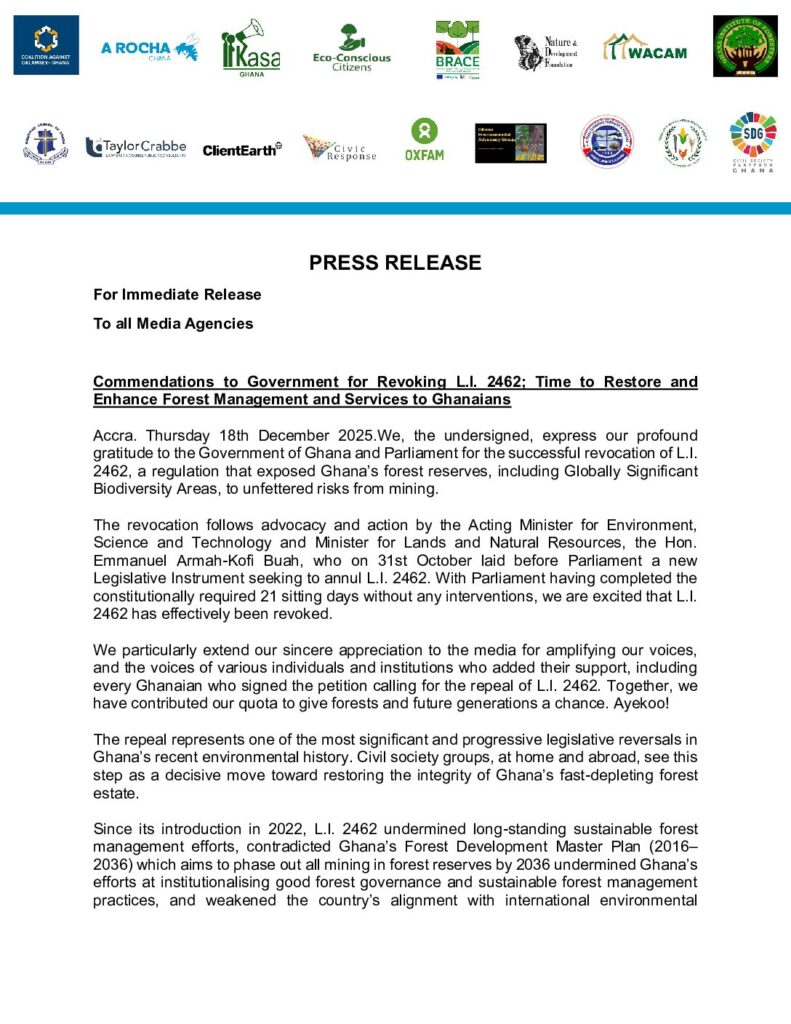
A coalition of environmental, faith-based, labour and civil society organisations has welcomed the revocation of Legislative Instrument (L.I.) 2462, describing the move as a decisive step toward restoring effective forest governance and protecting Ghana’s threatened forest reserves from mining activities.
In a joint statement issued in Accra on Thursday, the groups commended the Government of Ghana and Parliament for annulling the regulation, which they say exposed large portions of the country’s forest reserves, including Globally Significant Biodiversity Areas, to mining-related risks.

The revocation follows action by the Acting Minister for Environment, Science and Technology and Minister for Lands and Natural Resources, Emmanuel Armah-Kofi Buah, who on October 31, 2025, laid a new Legislative Instrument before Parliament to cancel L.I. 2462. Parliament subsequently completed the constitutionally mandated 21 sitting days without objection, allowing the repeal to take effect.
The coalition also praised the media, civil society actors and members of the public who supported advocacy efforts against the regulation, noting that public pressure played a key role in achieving what they described as one of the most significant environmental policy reversals in recent years.
Why L.I. 2462 Faced Opposition
According to the groups, L.I. 2462, introduced in 2022, weakened long-standing protections for forest reserves. Before its introduction, only about two percent of gazetted production forest areas were open to limited large-scale mining, with the remaining 98 percent fully protected. Under L.I. 2462, however, up to 89 percent of forest reserves became exposed to mining interests, placing more than 50 out of Ghana’s 288 forest reserves under serious threat. Even after amendments made in 2025, the coalition said nearly 80 percent of forest reserves remained at risk.
They further argued that the regulation contradicted Ghana’s Forest Development Master Plan (2016–2036), which seeks to phase out mining in forest reserves by 2036, and weakened the country’s alignment with international environmental commitments, including the Paris Agreement and the Convention on Biological Diversity.
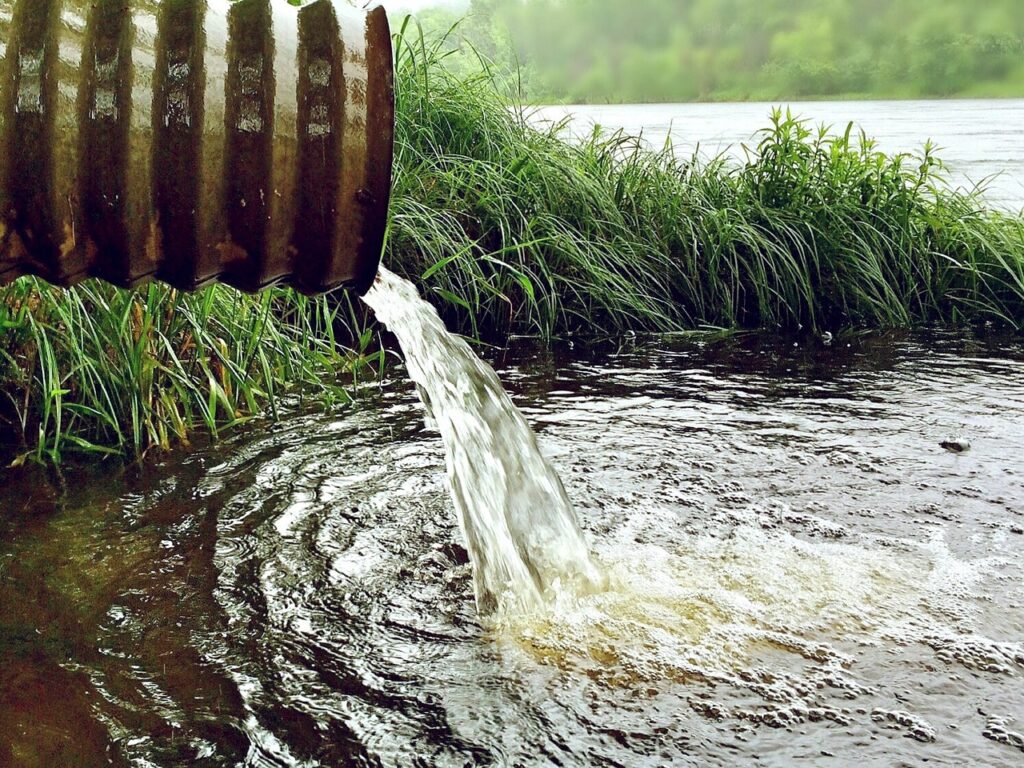
The statement also highlighted concerns that the regulation undermined institutional forest governance and endangered critical ecosystem services such as water protection, biodiversity conservation, climate regulation and livelihoods for forest-fringe communities.
Calls for Sustained Action
While welcoming the repeal, the organisations cautioned that Ghana’s forests continue to face serious threats from illegal mining, illegal logging, poaching and other forms of encroachment. They referenced comments by the Chief Executive Officer of the Forestry Commission, who has acknowledged improvements in forest conditions compared to the same period last year, but noted that significant challenges remain.
The coalition called on government to translate the repeal into broader reforms, starting with a review of the Minerals and Mining Act, 2006 (Act 703), to explicitly prohibit mining in forest reserves. They also urged the development and implementation of a National Forest Protection Strategy, in collaboration with national and international partners.
Additional recommendations included stronger enforcement against illegal activities in forest reserves, better coordination and full implementation of the “Tree for Life” programme to ensure tangible forest restoration outcomes, and the mapping and rehabilitation of degraded lands outside forest reserves, particularly those affected by mining.
The groups further appealed to government to urgently act on recommendations and proposals published by the Forestry Commission on December 15, 2025, with emphasis on strengthening the Commission’s capacity to address emerging and complex threats to forest sustainability.
Broad Coalition of Signatories
The statement was jointly signed by a wide range of organisations, including the Coalition Against Galamsey–Ghana; A Rocha Ghana; Kasa Initiative Ghana; Eco-Conscious Citizens; BRACE; Nature and Development Foundation; WACAM; Oxfam; the Christian Council of Ghana; ClientEarth; Civic Response; the Ghana Institute of Foresters; the Ghana Environmental Advocacy Group; the General Transport, Petroleum and Chemical Workers’ Union of the Trades Union Congress (Ghana); the Peasant Farmers Association; and the SDG Civil Society Platform Ghana, among others.
The coalition concluded that while the repeal of L.I. 2462 marks a pivotal moment for environmental protection in Ghana, sustained political commitment and accountability will be critical to securing the country’s forest heritage for present and future generations.
Story by Sheila Otuo – Baffour