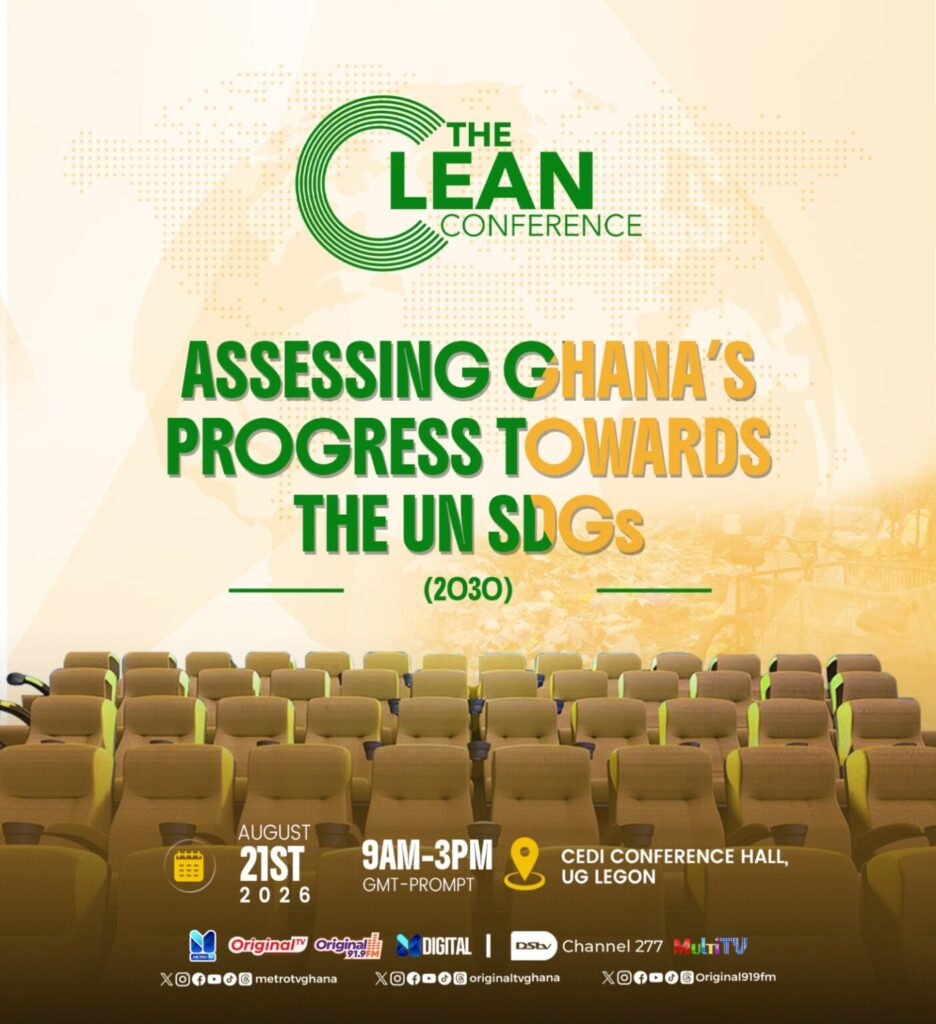
Policymakers, experts and business leaders to assess Ghana’s journey towards the 2030 targets
Ghana’s progress towards achieving the United Nations Sustainable Development Goals (SDGs) will come under renewed scrutiny as policymakers, development experts, academics, business leaders and other stakeholders converge for the maiden Clean Conference 2026, organised by Ignite Media Group, the parent company of Metro TV, Original TV and Original 91.9 FM.
The conference is scheduled for Friday, August 21, 2026, at the Cedi Conference Hall of the University of Ghana, Legon, under the theme: “Assessing Ghana’s Progress Towards the UN Sustainable Development Goals.”
The conference will be led by the Chief of Staff, Julius Debrah, and is expected to provide a platform for a frank assessment of Ghana’s achievements, challenges and priorities as the country approaches the 2030 deadline for the SDGs.
Adopted by world leaders in 2015, the 17 SDGs set out a global framework for tackling poverty, improving health and education, creating decent employment, protecting the environment and promoting inclusive and sustainable development.
With the 2030 deadline now less than four years away, the conference comes at a critical point for Ghana to assess whether the country is moving fast enough to meet the commitments it made more than a decade ago.
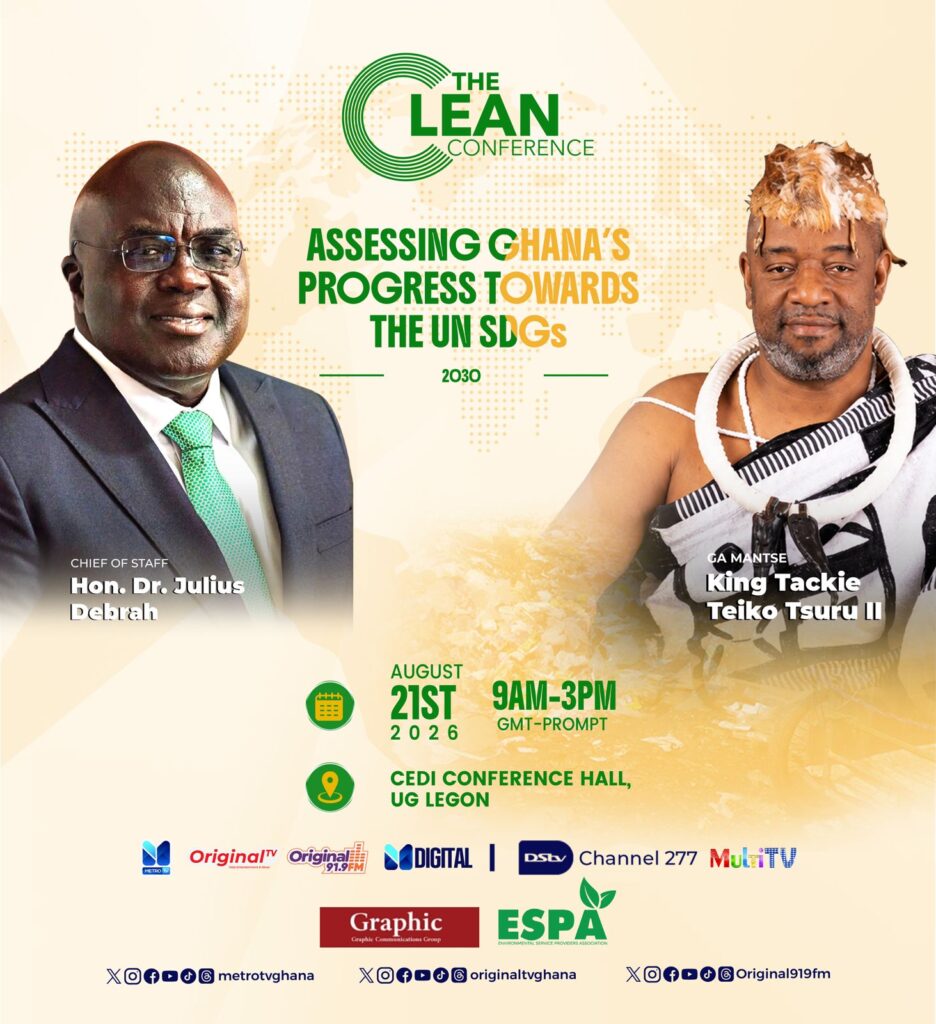
Assessing the gains
Ghana has recorded progress in several areas of development since the adoption of the SDGs.
Access to electricity has expanded, digital technology has transformed communication and access to services, while interventions in education and healthcare have created opportunities for millions of Ghanaians.
However, significant gaps remain.
Youth unemployment and the availability of decent and sustainable jobs continue to concern many households. Poverty and inequality remain challenges, particularly among vulnerable communities, while access to quality public services remains uneven.
Environmental degradation has also emerged as one of the country’s most pressing development concerns.
Illegal mining, popularly known as galamsey, continues to threaten forests, farmlands and water bodies, while poor waste management and inadequate drainage systems contribute to flooding and environmental pollution in several communities.
These challenges directly intersect with a number of the SDGs, particularly those relating to clean water and sanitation, sustainable cities and communities, climate action, life below water and life on land.
Beyond the conference room
The Clean Conference is expected to move beyond simply reviewing Ghana’s SDG scorecard to examining what needs to change to accelerate progress.
Discussions are expected to focus on areas including sanitation, climate change, economic growth, employment, education, healthcare, technology, environmental protection and resource mobilisation.
The gathering will also provide an opportunity for stakeholders to examine the role of government, the private sector, civil society, academia and the media in advancing the SDG agenda.
For Ghana to meet the 2030 targets, stronger collaboration among these sectors will be essential.
The country will also need to improve the way development resources are mobilised and utilised, while ensuring that policies and programmes produce measurable improvements in the lives of citizens.
A world struggling to meet the targets
Ghana’s challenges are occurring against a wider global backdrop.
The United Nations has repeatedly warned that the world is significantly off track in achieving many of the SDGs, with progress being undermined by economic pressures, conflicts, climate change, inequality and the lingering effects of global disruptions.
The challenge is particularly significant for developing countries, many of which face limited fiscal space and difficulties mobilising the resources required to finance development.
For Ghana, the remaining period before 2030 therefore represents a narrow but important window to accelerate implementation.
Climate and environmental sustainability
Environmental sustainability is expected to feature prominently in the Clean Conference, given the increasing connection between development and climate resilience.
Flooding, land degradation, deforestation, illegal mining, plastic pollution and poor waste management are no longer issues that can be treated separately from economic development.
They affect public health, livelihoods, food security, infrastructure and the country’s ability to withstand climate-related shocks.
The conference therefore presents an opportunity to examine how Ghana can pursue economic growth without undermining the natural resources on which future generations depend.
The media’s role
The decision by Ignite Media Group to convene the Clean Conference also highlights the increasingly important role of the media in the country’s sustainable development conversation.
Beyond reporting on environmental and development challenges, the media can provide platforms for public education, policy debate and accountability.
Through Metro TV, Original TV and Original 91.9 FM, Ignite Media Group reaches audiences across multiple platforms, creating an opportunity to take the discussions beyond the conference venue and into homes and communities.
The conference could therefore serve as a starting point for sustained public engagement on Ghana’s progress towards the SDGs.
A critical moment for Ghana
The central question facing Ghana is no longer simply whether progress has been made since the SDGs were adopted in 2015.
It is whether the pace and scale of that progress are sufficient to meet the 2030 targets.
The Clean Conference 2026 will provide an important opportunity for stakeholders to confront that question, identify areas where Ghana is falling behind and consider practical measures to accelerate progress.
With less than four years remaining, the country has limited time to turn commitments into measurable results.
The conference, therefore, comes at a crucial moment.
For Ghana, the SDGs are not simply international targets contained in a United Nations document. They concern jobs for young people, clean water for communities, quality education for children, accessible healthcare, a healthy environment and a better standard of living for all citizens.
The success of the SDG agenda will ultimately be measured not by the number of policies adopted, but by the improvements citizens can see and experience in their everyday lives.
The Clean Conference 2026 will seek to place that reality at the centre of Ghana’s development conversation.