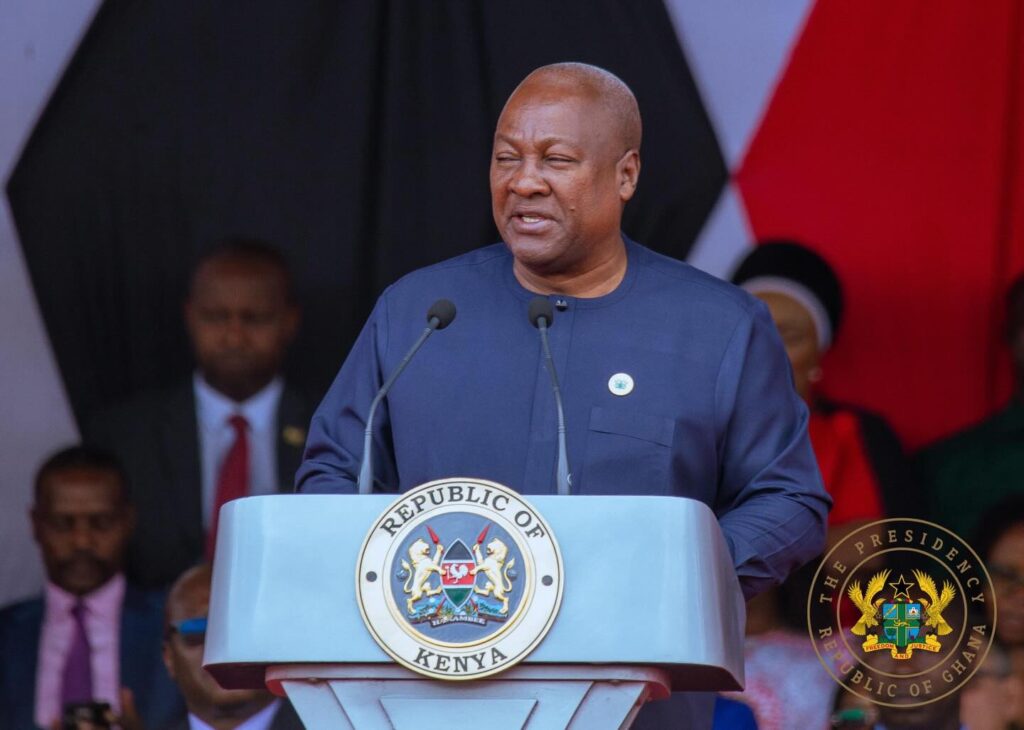
President John Dramani Mahama has unveiled the next phase of the Accra Reset at the World Economic Forum in Davos, calling for a decisive break from decades of aid dependency that have shaped relations between the Global South and the developed world.
Addressing global leaders, policymakers and development partners, President Mahama said Africa must no longer be viewed as a passive recipient of international assistance, but as an equal partner in shaping global development outcomes.
“If you believe the Global South deserves partnership, not pity, then join us,” he told the gathering, signalling a new approach to international cooperation built on mutual respect and shared responsibility.
The Accra Reset, he explained, is a practical framework rather than a political statement. It seeks to redefine how development initiatives are designed and implemented by ensuring that countries in the Global South co-create solutions with partners, instead of adopting programmes conceived elsewhere.
“This is not about seeking permission,” the President said. “It is about building momentum.”
Breaking the cycle of dependency
President Mahama said the urgency for change is driven by what he described as a “triple dependency” that continues to limit true sovereignty across much of Africa and the Global South. These include reliance on external powers for security decisions, dependence on foreign funding for health and education systems, and the extraction of critical minerals with minimal value retained by source countries.
He warned that as global humanitarian assistance declines, nations must rely more on their own capacity and regional cooperation to drive development.
The Accra Reset is supported by a high-level “Guardians’ Circle,” led by former Nigerian President Olusegun Obasanjo, which will provide strategic guidance and advocacy for the initiative.
From Ghana’s recovery to regional strength
Drawing from Ghana’s recent economic recovery, President Mahama highlighted measures taken by his administration to reduce waste, including limiting the size of government to 58 ministers, and restoring macroeconomic stability, with inflation returning to single-digit levels.
However, he stressed that national progress alone is insufficient. The Accra Reset, he said, aims to scale success through regional “Prosperity Spheres” where countries collaborate on infrastructure, investment, trade and job creation.
By negotiating collectively on issues such as trade terms, critical minerals and climate finance, Africa can strengthen its bargaining power and emerge as a more influential global actor, he argued.
A future built for the youth
At the core of the Accra Reset is a commitment to Africa’s young population. President Mahama said the goal is to create opportunities at home so young people no longer feel compelled to risk dangerous migration routes in search of a future elsewhere.
He predicted that the next phase of global progress would be shaped by African cities and capitals, including Accra, Nairobi, Kigali, Abuja and Cairo.
Momentum for the Accra Reset will continue beyond Davos, with further engagements planned at the African Union summit in Addis Ababa and the Oslo Dialogues.
President Mahama closed with a challenge to global partners: “The question is not whether the world needs this vision, but whether we have the courage to build it.”