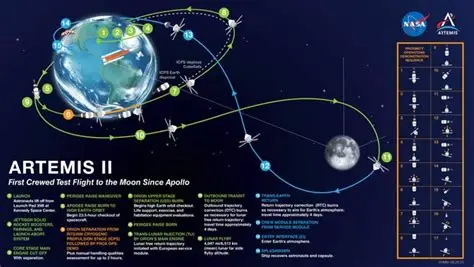
The world is turning its attention back to Earth as Artemis II prepares for its return, marking the successful completion of humanity’s first crewed mission to orbit the Moon in over five decades.
Led by NASA, the mission is widely seen as a defining moment in modern space exploration, reviving ambitions last seen during the era of Apollo program.
A Journey Around the Moon
Artemis II carried a four-member crew on a carefully planned trajectory that looped around the Moon before heading back to Earth. Among them is Christina Koch, whose participation has drawn particular attention in Ghana due to her academic ties to the country.
The mission did not land on the lunar surface but tested critical systems, including navigation, life support, and deep-space communication—laying the groundwork for future missions that aim to return humans to the Moon permanently.
The spacecraft traveled hundreds of thousands of kilometres beyond Earth, enduring extreme temperatures and radiation levels before beginning its re-entry phase.

Climate Implications: A Growing Debate
While the mission has been celebrated globally, it also raises important environmental questions—particularly for vulnerable regions like Africa.
Rocket launches, including those used in Artemis missions, release black carbon and other pollutants directly into the upper atmosphere. Scientists warn that these emissions can contribute to atmospheric warming in ways that differ from ground-level pollution.
For Africa, already grappling with climate vulnerability, even small shifts in global temperature patterns can have outsized consequences:
Rising temperatures affecting agriculture and food security
Changing rainfall patterns disrupting farming cycles
Increased extreme weather events such as droughts and floods
Though the number of launches remains relatively small compared to industrial emissions, experts caution that a rapid increase in space activity could amplify these effects over time.

Africa’s Stake in the Space Conversation
Africa’s role in the global climate conversation is evolving, and developments in space exploration are increasingly part of that dialogue.
Satellite technology often launched through similar rocket systems already plays a crucial role in climate monitoring across the continent, from tracking desertification in the Sahel to predicting floods in coastal regions.
The challenge, analysts say, is balancing the benefits of space innovation with its environmental cost.
Looking Ahead
As Artemis II concludes its journey, attention will shift to future missions that promise even greater milestones.
But alongside the excitement, there is a growing call for sustainability in space exploration ensuring that humanity’s reach for the Moon does not come at the expense of the planet below.
For Africa, the conversation is clear: space exploration may be global, but its climate consequences are deeply local.